

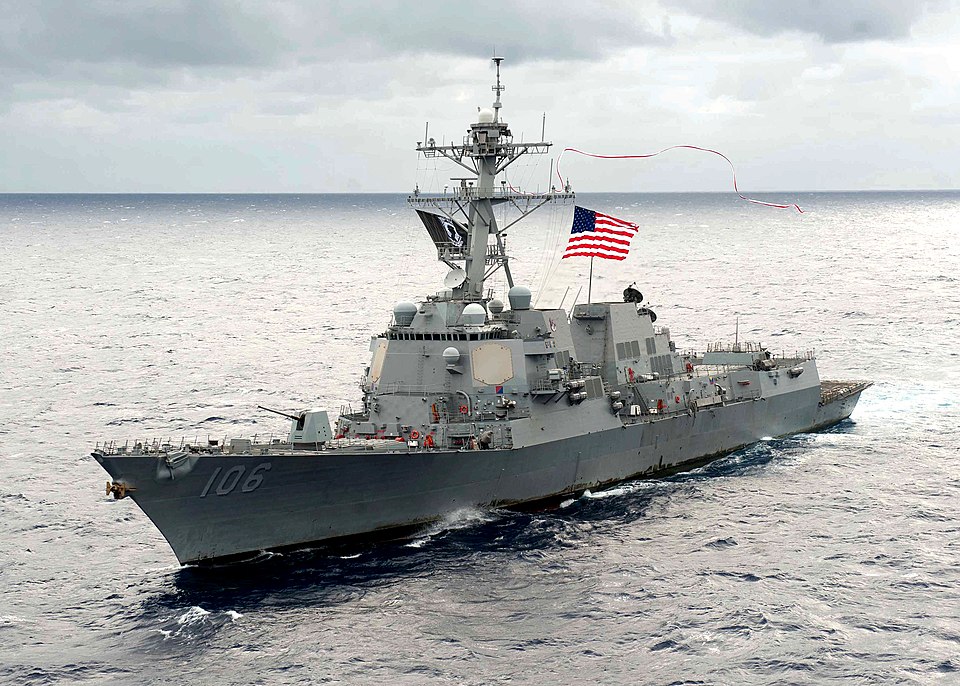
WEST CAPE MAY – Tyler and Dani Flynn, from West Cape May, spent the past five years of their lives traveling the globe on guided-missile destroyers engaged in some of the freshest conflicts in the world.
Tyler said that his ship, the USS Ramage, played an air defense role off the coast of Israel shortly after the Oct. 7 attacks. Dani, aboard the USS Stockdale, watched as her ship exchanged missile fire with Houthis off the Yemen coast as part of the ongoing Red Sea crisis. The Stockdale, during its 2024 and 2025 deployments, saw the most combat of any Navy vessel since World War II, and Dani was onboard for much of the action.
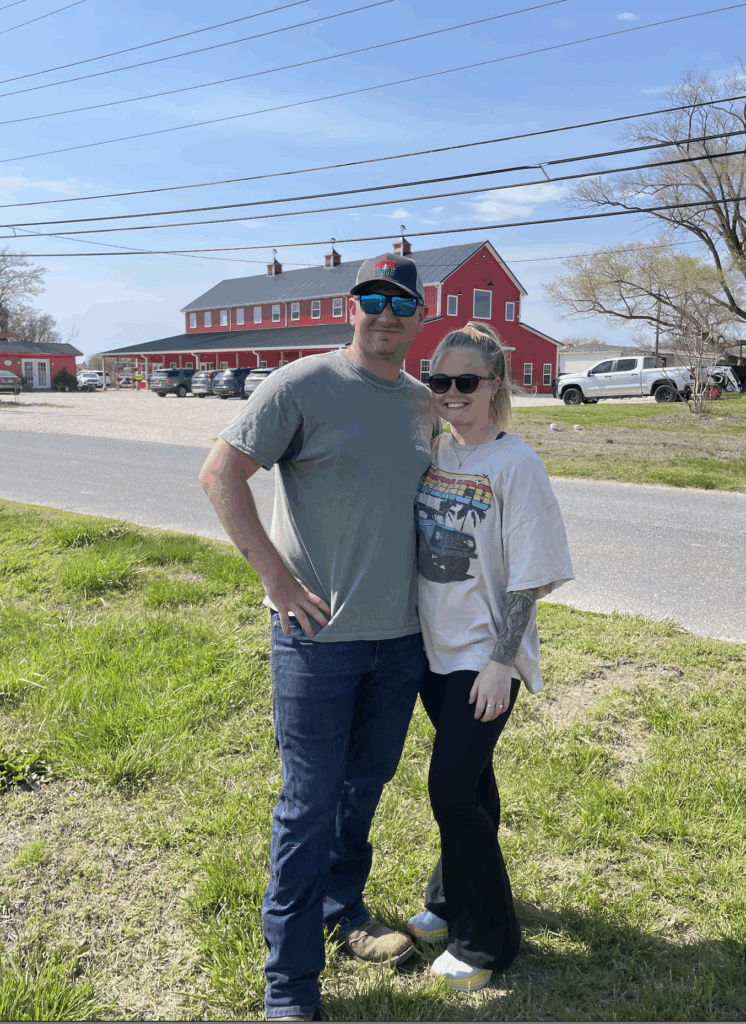
They’re among the youngest veterans in Cape May County, just 24 and 23 years old, and returned to West Cape May after years of service to work on the family farm while preparing for the next stage of life.
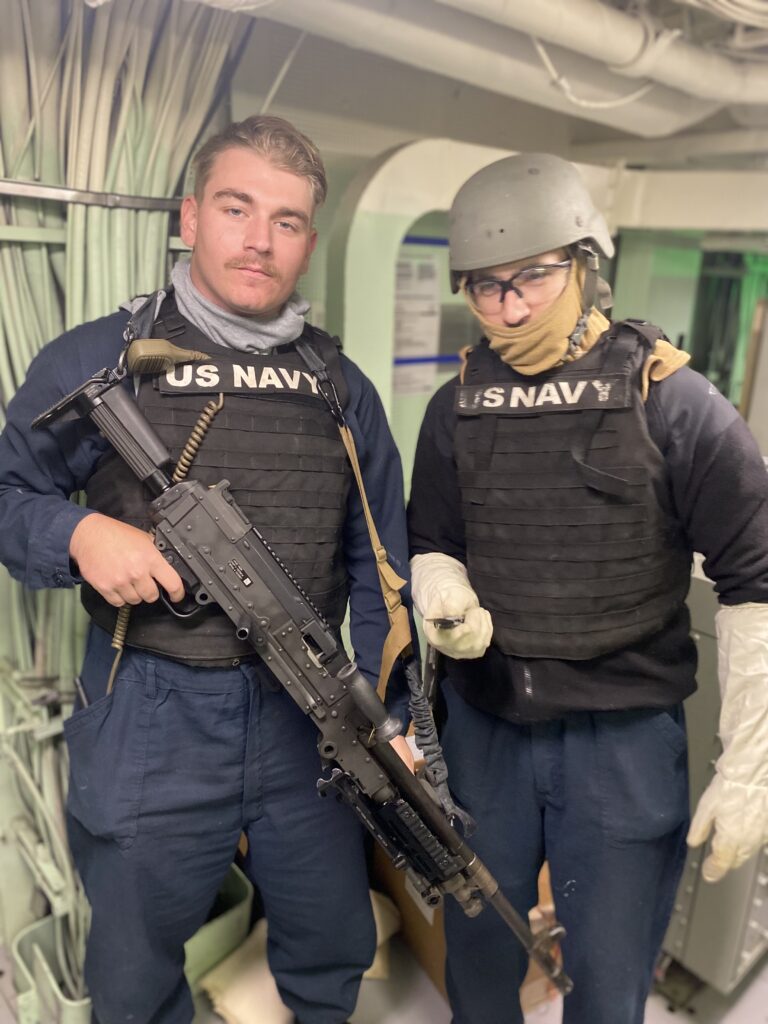
“But you start as a nothing,” Tyler said. He had no idea what he was getting into when he enlisted in 2020 at age 19, just a few weeks before the COVID-19 pandemic shut down the world. “I was a nothing painting walls, doing scutwork, the jobs nobody else wants to do. Sweeping, mopping, taking apart the dirtiest things on the ship.”
By coincidence, both Tyler and Dani served as sonar technicians. They work in the world of sound. “We see sound on the screen, and we can see what that sound is doing, what it is, where it’s coming from,” Tyler told the Herald.
It’s a common joke in the Navy, Dani said, that all sonar techs do all day is listen to dolphins and whales, two of the loudest animals in the ocean. The sonar technology that American sonar technicians use is so sensitive that Tyler and Dani could hear colonies of shrimp passing in nearby water. That’s the difficulty of the job: figuring out what could be an enemy or an obstacle, and what’s just noise.
Tyler memorized more than 100 equations for the job and often did the calculations by hand. But on Dani’s ship, work that was tedious for Tyler was made easier with newer technology.
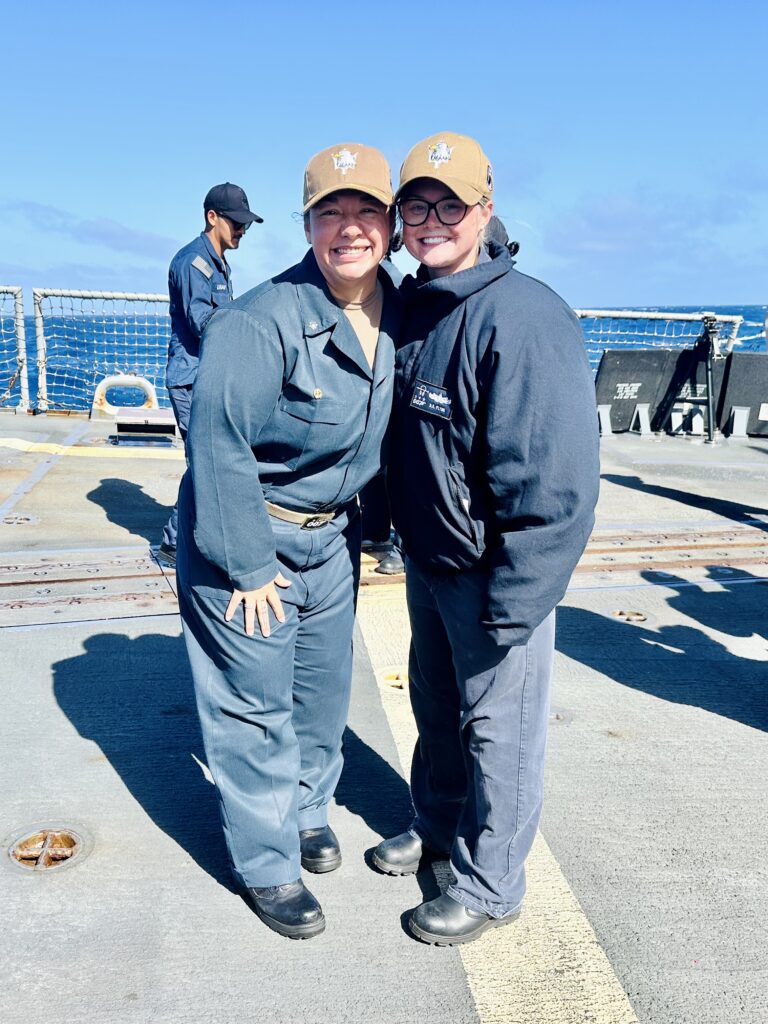
She remembers being packed in tight quarters with a dozen women of similar rank. “I had a berthing of about 12 different girls, we slept in what felt like coffins,” she said. “We had two toilets, one shower.” She filled her off-hours with reading and chess. “I was flying through books. I read probably 70 books on my second deployment.”
Dani joined the Navy in 2021, in the middle of the pandemic. “I sat in a hotel room for two weeks as part of quarantine,” she said. Days after turning 19, she was deployed on a 363-day mission. “We ended up getting dry-docked in Japan for two months for ship repairs,” she said. “We wouldn’t have made it home; we had a bunch of damage to our ship.”
Japan became a rare bright spot amid long stretches at sea. “Their culture is so amazing,” Dani said. “I took the bullet train to Tokyo, I got to go to a five-star restaurant, eat Wagyu beef.”
Her later deployment to the Red Sea was far from peaceful. “We were going back and forth picking up ships and bringing them through,” she said of escorting merchant vessels through contested waters near Yemen. The Bab-el-Mandeb Strait, between Yemen and the Horn of Africa, remains a volatile choke point as the Gaza war continues to stir regional tensions. The Houthis, an Iran-backed militant group aligned with Hamas, have targeted Israel-linked and U.S. ships, as well as commercial vessels, passing through the strait.
By late 2023, the Houthis had begun launching missiles and drones at vessels they linked—rightly or wrongly—to Israel or the United States. When Dani was aboard the Stockdale, she watched as her ship returned fire. “The amount of adrenaline was crazy,” she said. “These people were actually trying to blow us up.”
Tyler’s deployments carried a different kind of pressure. He worked joint NATO operations in the Atlantic and Mediterranean, where accuracy mattered above all else. “We did a lot of math, a lot of geometry; using sound to find and kill a target, that’s cool,” he said.
Over time, the “nothing” he once was became a leader responsible for the armory and eventually for an entire division. “When I first made second class, I had already been running a work center,” he said. “When they said I was going to take over an entire division, I was very scared. If somebody had to talk to the captain, they sent me. I knew what I was talking about, but I was a low enough rank that he wouldn’t yell at me.”
The Navy, both said, was an education in adulthood. “You get thrown into being an adult,” Tyler said. “You’re either going to be the worst adult ever, or you’re gonna be a really good adult. If you’re a really bad adult, there are good adults that can come help you not be terrible.”
Dani agreed that the experience prepared her for life beyond the military. “As much as I loved the military and am thankful for the opportunities I had, it made me into the person I am today,” she said. “I was ready to get out and start a family and have a more stable lifestyle.”
The pair met early in their Navy years in San Diego, when Tyler was assigned to pick up new arrivals from the airport. “He was on pickup duty,” Dani said. “I went to my first boat a few days after I turned 19.” They stayed in touch for two years while serving on opposite coasts, navigating the same job under different circumstances.
Tyler eventually turned down another promotion. “The military wasn’t really where I wanted to be anymore,” he said.
Dani said she learned more than she ever imagined she would during her years in the Navy. It was a hard life that required constant travel. Her time was defined by her work, and she was often at the mercy of forces much larger than her own plans.
The couple is moving to Knoxville, Tennessee, where Tyler is joining a two-year nursing program at Jersey College’s School of Nursing.
He was inspired to join the medical field after taking an advanced medical course in the Navy. A destroyer-class ship typically has around 300 crew members. With a team that small, flexibility is essential. The average joe needs to be able to step up to save a life. Tyler learned how to administer IVs, perform blood transfusions in emergencies, and help save the lives of his fellow sailors.
Tyler put it simply: “Everybody needs to know how to save the ship.”
On one Arctic mission, one of Tyler’s superiors suffered a heart attack. The destroyer crew, without a rescue helicopter aboard, had to try to save him while help arrived from elsewhere. “We did CPR on him for over two hours. It was really intense,” Tyler said. “Our ship didn’t have a helicopter on board; we had to go two hours near Norway to get a helicopter out. That was one of the defining points of my career.”
After separating from the service, the couple moved back home to a slower life in West Cape May. They’ve been involved with operations on Tyler’s family farm while he gets ready for nursing school. The couple is waiting out the ongoing government shutdown, which has made it impossible for them to apply for veterans’ loans and other forms of aid that will make medical school feasible.
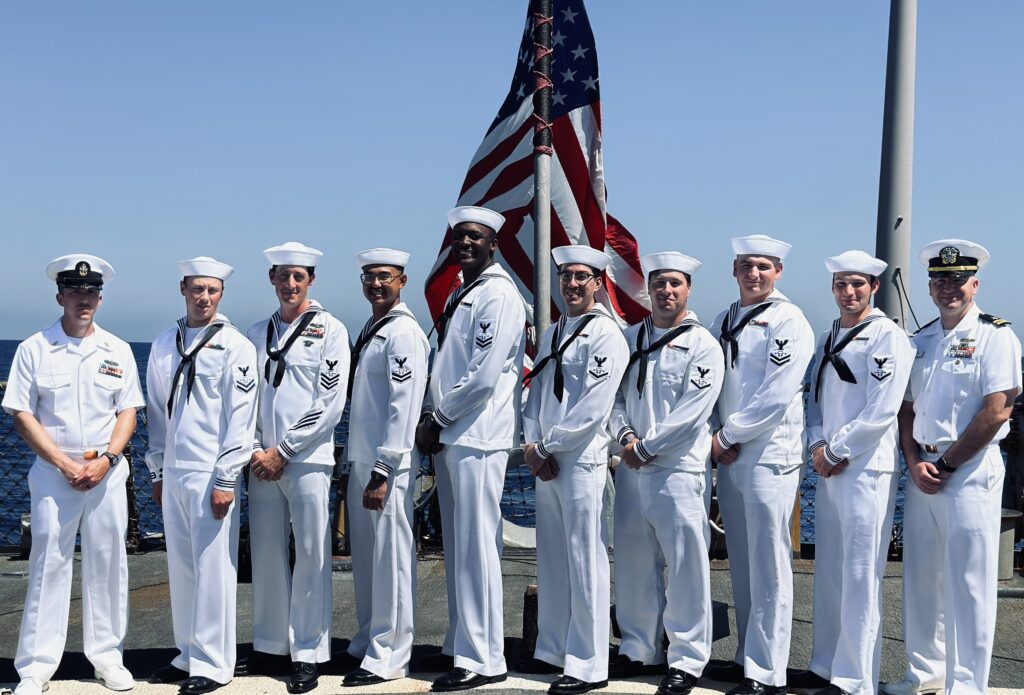
Both say the Navy gave them confidence to tackle what’s ahead. Dani said the same skills that kept her steady at sea now guide her at home.
“It shows you what you can pursue,” she said. “You really learn a lot about life.”
Contact the author, Collin Hall, at 609-886-8600, ext. 156