

Hurricane Erin had a rendezvous with Cape May County Friday and Saturday, but let it off relatively easy.
Things could have been far worse than they were, and officials up and down the Shore were grateful that the hurricane came no closer.
At one point, Erin was a Category 5 hurricane, with wind speeds topping 158 mph, but she sputtered as she approached New Jersey.
The consensus among local officials: Whew!
Erin stayed far enough offshore that the ocean surge that might be associated with a Category 5 hurricane did not materialize. Nor was the rainfall as overwhelming as it could have been.
What did happen in Cape May County:
• Significant coastal flooding, mainly along low-lying areas along the bay front.
• Dangerous rip currents that kept beaches closed for periods of time, and then open but with restricted water entry.
• Significant beach erosion, mostly in the hot spots known to be vulnerable to erosion. In fact, the long-term problem in ocean-fronting communities will be beach sand lost to erosion.
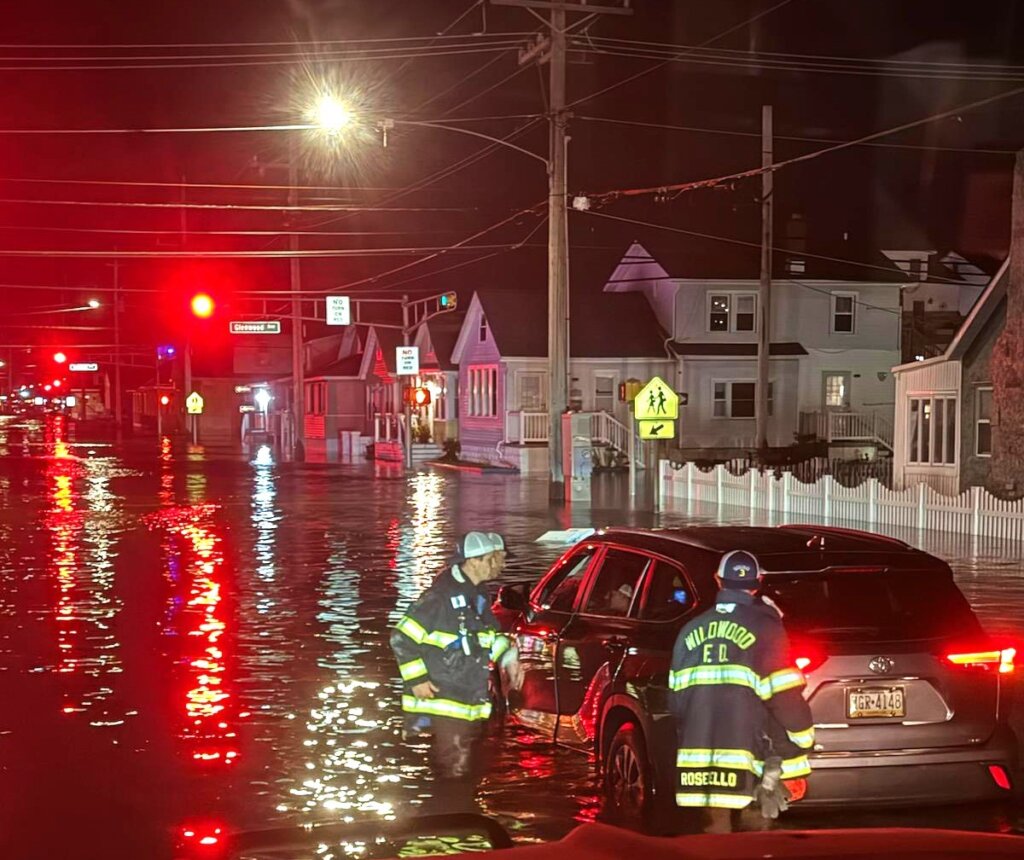
By Saturday morning, things were mostly back to normal along the shore. The Wildwood boardwalk was jammed. The Wildwood beaches were open, but beachgoers had to negotiate their way around small lakes pooled on the wide beach.
Things were calm in Wildwood Crest; people were headed out onto the beach and the crowd seemed normal. The Delaware Bay beach in Villas was totally normal.
Before the storm arrived, Gov. Phil Murphy declared a state of emergency for all 21 New Jersey counties, opening the way for state aid if it was needed.
Here’s a town-by-town glimpse:
Ocean City: The city’s 8 miles of oceanfront beaches took a pounding from Erin, even though the storm stayed about 200 miles offshore. South-end beaches had significant erosion, and small cliffs, created by erosion, line many of the beaches.
Mayor Jay Gillian said the city had its highest tides in seven years, a full 3 feet above a normal high tide. Gillian said the dune system did a “great job in protecting our homes and streets.”
Still, some businesses and homes had ankle-deep water lapping against their foundations.
Ocean City is scheduled for a federal beach replenishment in early 2026. Gillian says his focus now is ensuring that the federal government allocates the money needed for the project.
Strathmere: This community, a bridge away from Ocean City, had major erosion.
Sea Isle City: Flooding was deep enough for kayakers to get around on streets. Surf conditions were hazardous, and rip currents were life-threatening.
Flooding was a major concern, and closed down the Townsends Inlet bridge at times. As the flooding at high tide subsides the long-term problem in Sea Isle and the other ocean-fronting communities in the county will be sand lost to erosion.
Avalon: The dunes held and did their job, but beaches in the borough’s north end have been substantially narrowed, and beach access pathways will need repair.
Mayor John McCorristin said the borough’s beaches have retreated as much as 40 feet from the waterline. While some beach entrances were closed, the beaches reopened quickly, and administrator Scott Wahl said Saturday that “beach patrol reports all back to normal.”
Overall, Wahl said, a “week of northeasterly winds just set the table for Erin to come in and take some north end beach away.”
Stone Harbor: Mayor Tim Carney said Stone Harbor “fared pretty well,” except for flooding on some low-lying streets and the 80th Street marina, a hot spot for tidal flooding. Carney said that, about an hour before high tide Friday, water was spilling over a ramp and coming up from a drain in the center of a parking lot.
The mayor said the erosion was not significant as of Saturday morning, when he noted that Congressman Jeff Van Drew would be meeting with coastal mayors on the issue of federal beach replenishment dollars. Carney said it is a priority “to reinstate the federal support necessary to continue protecting our community.”
Cape May: Mayor Zach Mulloch said he was pleased at the low level of erosion the city suffered. Mullock said there was some erosion “but not a lot of scarping, fortunately.”
He said high-tide flooding came right up to the dunes. Social media showed water spilling into the street at Poverty Beach in the city’s east end, but not at significant levels.
Reiterating what the other mayors said, Mullock said, “My main concern now is beach replenishment funding and the seawall funding.” Cape May is in line for major federal support for extending its sea wall.
North Wildwood: Council President Sal Zampirri said flooding and beach erosion was a problem.
“The beaches were hit pretty bad, but everything is open today,” Zampirri said on Friday, Aug. 22.
The mayor said the back bay water height was 7.9 feet for high tide, which brought water to New Jersey Avenue, “but not deep.”
“Tonight, it will be a little less – 7.1,” he said.
Zampirri said the city held an Office of Emergency Management meeting on Thursday, Aug. 21, with police, fire, emergency management officials, the mayor and himself.
“The way it was, it was described as we had a bad high tide,” he said.
The mayor said “a few boneheads” tried to surf, and the city had to go down to the beach and tell them to get out of the water.
At about 6:30 p.m. on Thursday, North Wildwood had 300 to 400 people going down to Second Avenue and JKF Boulevard to see the waves crashing over the seawall. Zampirri said people, including children, were getting in the way of the waves and then racing out into the street.
In response, he said, the city closed that part of the street, so people fleeing into the street wouldn’t be hit by a car.
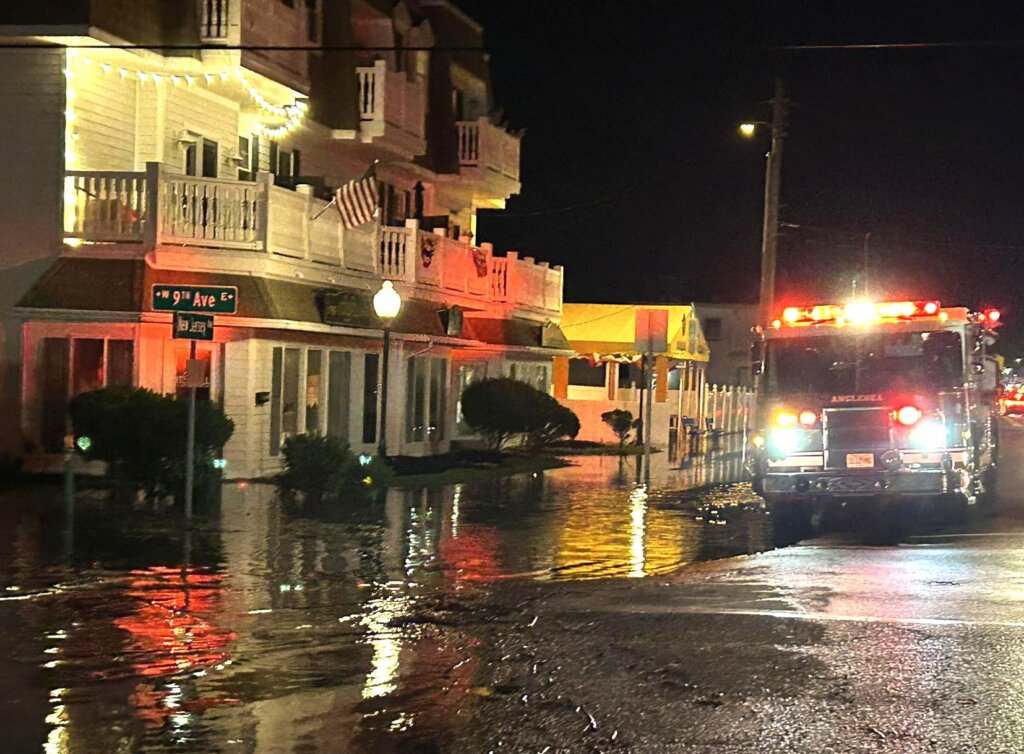
Wildwood: Deputy Mayor Steve Mikulski, the director of public safety, said flooding closed Rio Grande Avenue coming into Wildwood from the George Redding Bridge.
“The 8-foot tide exceeded the pumping station capabilities,” Mikulski said. “Once the water exceeds certain levels, the pump shuts off.”
Mikulski likened that situation to an overflowing bathtub, saying it “does no justice to keep it pumping.” However, he added, once the water gets down to a certain level, the pumps reactivate and take care of the street flooding.
“That’s exactly what happened. When the pumps got going, the water went away immediately,” he said.
Mikulski said water was coming over bulkheads on the bay side, but there were no issues on the beach. He said early Friday morning was the only time the beach was closed, although the ocean was closed for bathing. He said on Friday at about 10:30 a.m., guards were at the stands and the beach reopened at 11:30 a.m. In the meantime, he said, public works did a great job cleaning up debris left by the ocean. The water dislodged some wooden walkways, trash cans and beach boxes, which were put back in place.
“Everyone chipped in, public works, the beach patrol, fire, EMS, the police; they all did a great job,” he said.
West Wildwood: Administrator Donna Frederick, a lifelong resident of the borough, described the flooding as “moderate.”
“The interesting thing is they said the level of the bay was the fifth-highest it has ever been, but as far as the borough, we were very lucky. I think we dodged a bullet,” she said. “It was moderate, not major.”
Frederick acknowledged that, to recent arrivals to the borough, 2.5 to 3 feet in the street in lower locations would look like major flooding. But she said she did not hear that water had entered anyone’s home, and the street flooding had disappeared in two tide cycles, or 24 hours, which she said is normal.
She said the borough had no real damage as a result of flooding, but had to deal with some debris. She said a lot of bulkheads had been elevated over last few years, and that helped. Still, she put out five emergency broadcasts to alert people to possible flooding and to advise them not to drive in flood water.
Frederick said on Monday that, with the weekend to dry out, some crews were out taking care of cleanup.
“All in all, we’re in pretty decent shape. It was a good dry run, or wet run, so to speak,” she said.
She said there was a problem with the borough’s flood whistle, which sounds daily at noon. She said that, as fate would have it, the siren stopped working on Thursday, and there is no mechanism to activate the siren remotely.
Wildwood Crest: Mayor Don Cabrera also described flooding as moderate. He said the flooding was essentially on the bay side between Morning Glory and Rambler roads, an area where the borough has been elevating bulkheads.
However, as happens, during high tide the bay water came up through valves, but not as badly as in the past, he said. He believes that the wind pattern, coming out of the east, was in the Crest’s favor.
As to beach erosion, the mayor said the ocean came over the top of the beach berm on the ocean side, and made it to the foot of the existing dune system.
“The erosion to the dune was minimal,” he said. “As for the beach itself, this levels out the beach.”
He said some walkways were broken but no port-a-potties were tipped over because they are anchored in place.
Cabrera said some people questioned why the borough did not pull all its assets off the beach, including beach boxes. He said it takes about a month to place all those things on the beach, and itwould take a month to get them off. He said it would cost less to repair any damage than it would cost to take assets off the beach and put them back.
All in all, he believes the borough fared pretty well, and its dune system held up to the storm.
“The proof is in the pudding,” he said.
Lower Township: The most flooding was in the areas that typically flood during very high tides – Schellenger’s Landing, especially Wilson Avenue and the area near the Lobster House. Township Manager Mike Laffey said the Two Mile Landing parking lot was underwater.
The good news: Laffey said flooding has been mitigated by the installation of outfall pipes, and the township has plans for more.
“The outfall pipes are helping with town flooding, and there was not a lot of rain, and that helped,” he said.
Laffey said the Village Road beach path is gone and has to be rebuilt, because it is an emergency beach access for water rescues.
Otherwise, the post-storm cleanup involved debris on the bay-side beaches, and some beach paths had to be raked back into shape where there was some scarping from the tide.
Editor’s note: This story was reported and written by Tom Kearney, Christopher South and Vince Conti.