Cape May, Naturally is a twice-monthly column about nature written by a rotating cast of experts at the New Jersey Audubon.
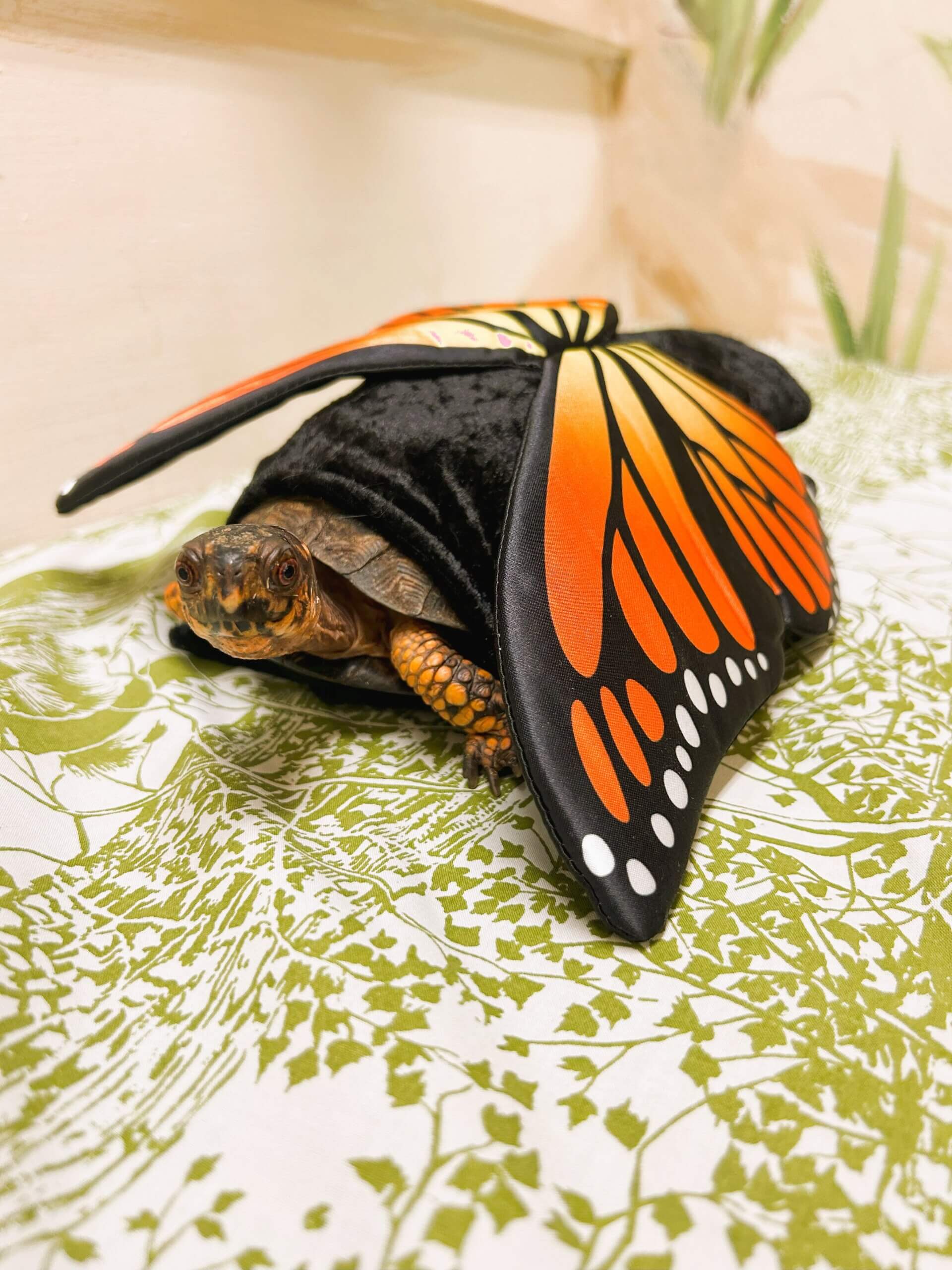
I have had an unusual abundance of box turtles in my yard this summer. I’m fairly certain my friends are tired of hearing about them, even though I’ve given them catchy, lovable names like Goldie, Half-pint, Mr. Stripey, Peachy and Nugget. Goldie and Half-pint seem to hang out together, with Goldie being, you guessed it, twice as large and the largest I regularly see. Peachy is distinctly orange on his/her legs and neck and has a very steep shell. There’s Darth Vader, too. He/she is dark and mysterious.
I never pick them up, so I don’t know which are males or females. I’ve learned that I might be able to tell by the color of their eyes. In most cases, but not all, male’s irises are red or orange, and a female’s are brown or yellow. If I were to pick them up, I’d be looking for a slightly concave lower shell, aka “carapace,” for a male, and no concave in the carapace of a female. I just enjoy watching them amble around, eating the tomatoes I sometimes offer. I also take pictures of them, most of which are terrible.

Their name is derived from their unique ability to clamp their upper and lower shells shut tight, like a box, offering protection from predators, and sometimes, each other! The markings on their shells help them blend into the forest floor.
Eastern Box Turtles may be about as close to a pre-historic creature as you’ll run across in the wild around here, after Horseshoe Crabs, that is. A fossil found in 2008 indicates “turtles” date back 250 to 200 million years to the Triassic Period, around the same time the first dinosaurs appeared. Horseshoe crabs have existed an amazing 450 million years, back to the Paleozoic Era. Now there’s a fun fact for trivia night!
Eastern Box Turtles specifically date back about 15 million years. They are reptiles, just like snakes, lizards and alligators. They “hibernate” by digging underground when temperatures approach freezing, eventually reaching a dormant state when their heartbeat has fallen from about 40 beats per minute to one beat every five to ten minutes.
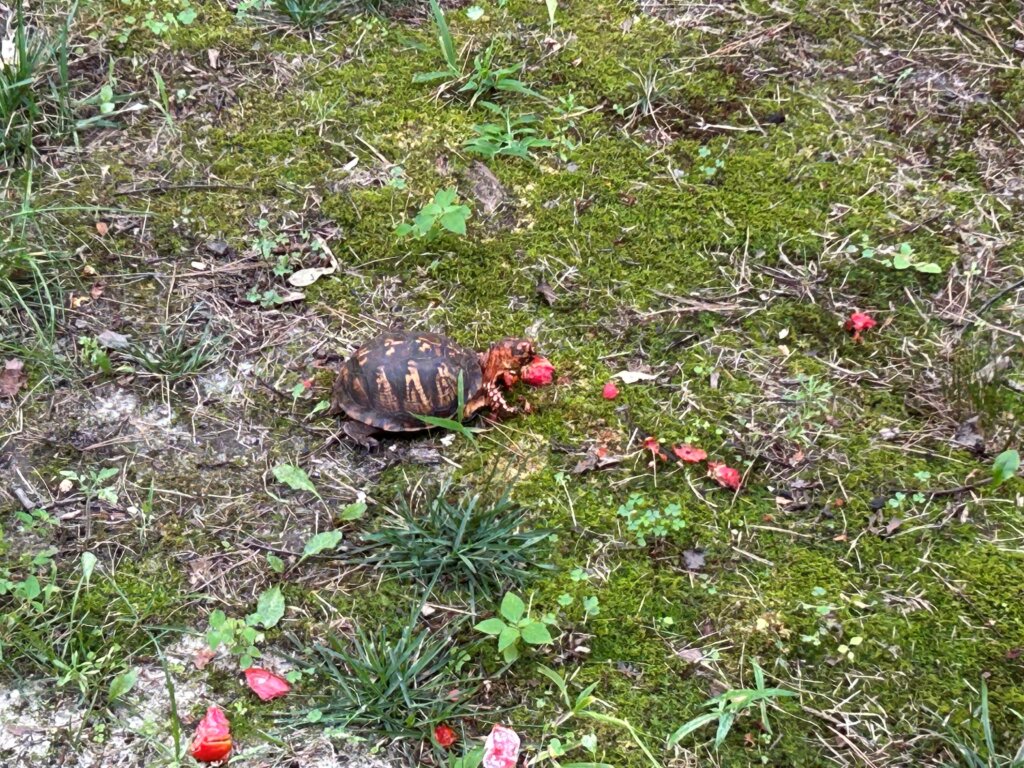
Come spring, they emerge and are most active in the morning and evening, preferring shade during the heat of the day. They have no ability to regulate their body temperature, so they’ll seek a cool, dark place once they’ve foraged for a while. Using their keen eyesight and superior sense of smell, they are opportunistic omnivores, which means they’ll eat just about anything. They prefer earthworms, caterpillars, beetles, slugs, flowers, berries, fruit that has fallen off trees, and even some leaves and grasses. Oh, I should add tomatoes and peaches to that list, at least in my yard.
Mating takes place in spring and summer, and later the female digs a hole and lays four to six eggs. She’ll then cover the eggs and be on her way. She never returns to the nest and the young turtles are on their own as soon as they hatch 70 to 90 days later. Emerging box turtles are susceptible to predators especially because their shells are still soft. Their average life expectancy is about 50 years, and some have lived to be 100.
I found a great list of ways we can help Eastern Box Turtles on the website of the Maryland Zoo and here are the ones that apply to us here in South Jersey:
- Never remove a turtle from the wild.
- Never relocate a turtle in the wild, unless you see one trying to cross a road. Help a turtle cross a road only if you can do so safely and be sure to point it in the same direction that it was headed.
- Never return a pet or rescued turtle to the wild without first contacting an expert.
- Educate friends and family about the importance of observing – but not touching, disturbing or collecting – turtles in the wild.
- When visiting wetlands, tread lightly and stay on designated paths.
- Avoid using pesticides and other hazardous materials and if necessary, dispose of them properly to insure that they do not end up in waterways.
- Recycle in order to reduce waste and reduce the need for landfills.
Box turtles are a treasured part of nature here. If you’ve never seen one in the wild, you should visit New Jersey Audubon’s Nature Center of Cape May to meet Tina the Turtle, and all the critters carefully tended to there. And if you do see one, take a moment to appreciate it from a distance. They are truly amazing and majestic creatures.