

ERMA – As more municipalities joined Cape May County’s centralized 911 dispatch service, much was made of the ability of the dispatchers, who are based at Cape May Airport, being able to send emergency personnel to the proper place.
The claim is that the dispatchers don’t necessarily know the town the way the towns’ own employees do.
Chris Leusner, coordinator of the county Office of Emergency Management, recently provided the Herald with an opportunity to see how the dispatch center uses state-of-the-art technology to identify a caller’s location to within about 50 feet.
A system called Live 911 interfaces with another program, Rapid SOS, with Live 911 providing the voice data and Rapid SOS providing the location by using GPS; the two systems are always working simultaneously.
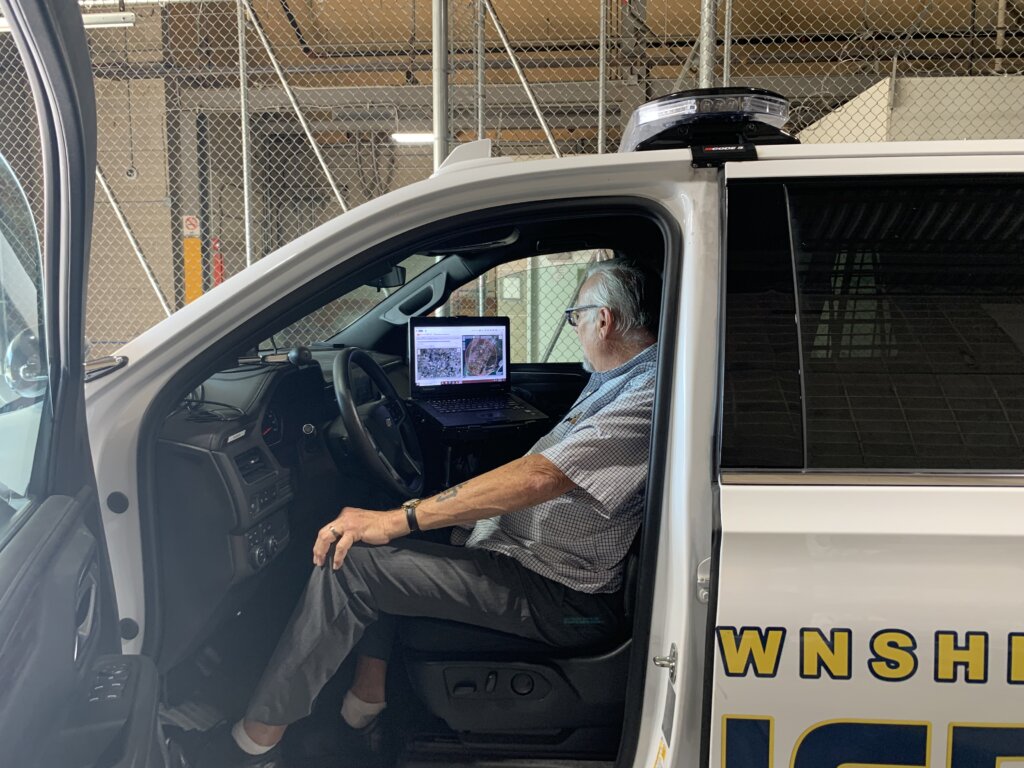
The information is transmitted to police vehicles in the municipality. The system, which cost about $45,000, notifies the officer behind the wheel, who can actually start rolling toward the location before being dispatched, essentially cutting the response time in half.
Kevin McLaughlin, a division director for OEM and a retired Wildwood police captain, said the dispatcher can then stay on the line with the caller, getting additional information or providing reassurance.
“The feedback we are getting from police departments is very positive,” McLaughlin said of the system.
All of the 911 caller’s information, rather than being evaluated only at the county dispatch center, is transmitted to the mobile data terminal in police vehicles.

Capt. Mike Majane of the Lower Township Police Department, which shares a building with county dispatch, the courts and the ambulance service, said the main monitor for Live 911 is in the squad room, but all police supervisors have Live 911 on their desktop computers.
Majane said that in one instance officers were advised of a fire and began rolling toward the scene immediately. He said if there is a call with a weapon involved, the officers can be notified as they are on their way.
Leusner said the dispatcher is able to provide context to the call that would be helpful in dealing with people once the officer arrives, what is known as “situational awareness.”
“It allows the officer to protect themselves and the community,” he said. “The more information you can provide to the responders the better public safety you are providing.”
The information posted on Live 911 also crosses police jurisdictions, in the event someone is fleeing from one municipality to another. Lower police’s Jordan Saina said it is possible to hear where other calls are going, or to set up a geo-fence to block out calls in other areas.
The technology also allows a cellphone to be tracked to its location. If the cellphone moves because the caller is walking, the system tracks the movement.
The combined technology in another instance allowed the dispatch center to identify the location of a yacht that had been struck by a tanker on the ocean. The tanker operators did not even know it had struck the boat, but thanks to GPS tracking all four men on the yacht were rescued, McLaughlin said. The system determined latitude and longitude and let the dispatcher know exactly where the yacht was located.
The county uses its computer-aided dispatch (CAD) program, with input from local fire chiefs, to create fire response plans that allow them to establish target hazard zones. An example is Cape May, which has many wood-frame buildings that are close together. It will also list structures such as Victorian Towers, which likely would require a ladder truck or other specialized equipment.
Leusner said a lot of the technological upgrades, which are still going on, were possible because of a $1.5 million grant to update the 911 system to Vesta 911.
“We are using a Motorola CallWorks system, and we are upgrading to Motorola Vesta, the next-generation 911-compliant,” he said.
He said the state will be requiring a more modern and resilient platform, which will provide a lot of new features. The Vesta 911 system is scheduled to go live this fall.
The county is also installing a Phoenix G2 system, which automates the instantaneous dispatch of fire and EMS, cutting response times.
“It uses speech-detect technology rather than a dispatcher broadcasting the message,” Leusner said.
He said the older systems were all based on land lines, but the next generation of 911 equipment is all cellular-based.
“The county has taken public safety very seriously,” Leusner said. “It has been preparing for six years for all this.”
According to Leusner, a lot of towns needed to upgrade their 911 systems. Middle Township and Wildwood were looking at making significant investments, he said, and Cape May lost its 911 dispatch system due to a lightning strike.
McLaughlin said there are six to 10 dispatchers working at a time. He said the dispatch center is also using training technology called Comms Coach, which is an artificial intelligence platform. It provides evaluation of incoming calls and radio interaction, and the dispatchers-in-training get feedback through a dashboard in the system, suggesting improvements.
Leusner said, “It really enhances quality assurance and accelerates training and skill development of new communication operators. You can use it to create simulations for dispatchers in training and new dispatchers.”
Contact the reporter, Christopher South, at csouth@cmcherald.com or call 609-886-8600, ext. 128.