
WILDWOOD – One of the youngest survivors of the Auschwitz-Birkenau concentration camp told of her experiences and the atrocities she witnessed to a full house Aug. 17 at Beth Judah Temple.
Tova Friedman, who was 6 years old when she walked out of the death camp in 1945, wrote the bestseller “The Daughter of Auschwitz” and has traveled around the world, sharing her vivid memories and speaking out against extremism and violence. She has also authored two other books about her experiences, one geared toward children.
“Why do I travel and talk so much about this?” she asked the audience, some of whom were children of Auschwitz-Birkenau survivors. “Because this is not just my story; I am only one person, and it would not be so significant. But 1.5 million children were murdered: They starved, they were shot and gassed because they were Jewish. That was the only qualification. So I am speaking for them.
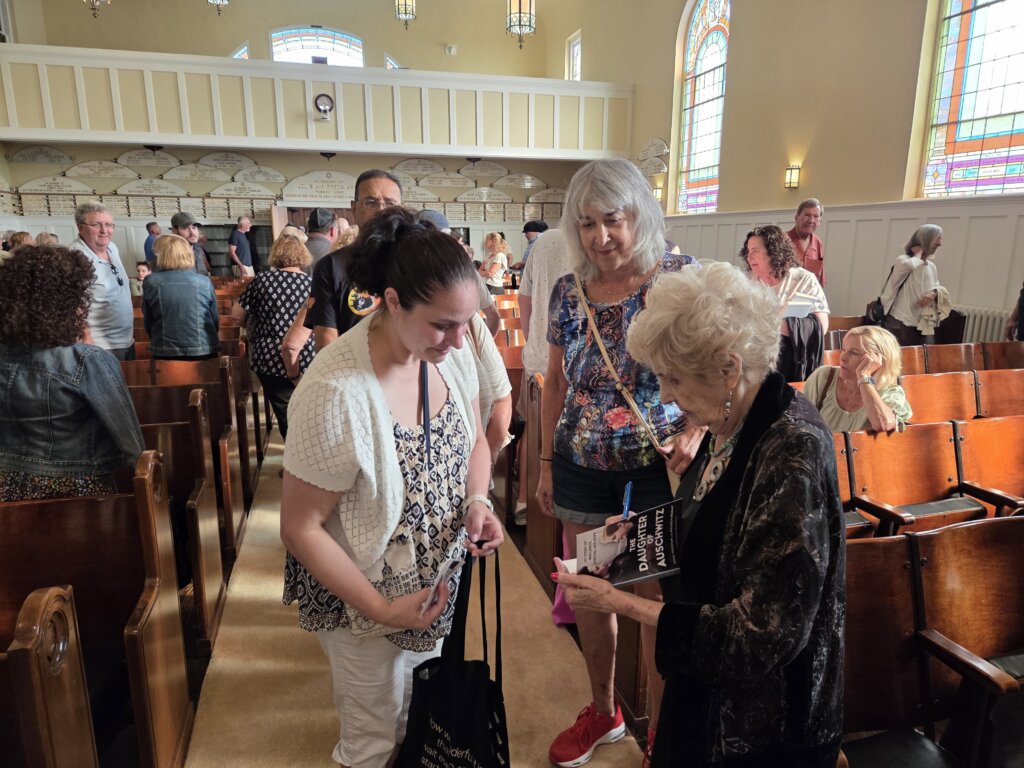
“I survived mostly because of luck. The world is not getting any better; it’s getting worse. Antisemitism is everywhere. Germany has become our friend, which is weird. Young people don’t know about the Holocaust; many don’t believe it happened.”
In her book, she wrote: “The Holocaust, the worst crime in the history of mankind, happened less than 80 years ago, and it’s fading from memory already? That, quite frankly, is appalling.”
Friedman recalled living as a young girl in one of the Jewish ghettos in Poland, each ghetto associated with a specific town. Her family was from Tomaszow Mazowiecki, about 75 miles southwest of Warsaw, where Jews were forced to live in a ghetto formed of six four-story buildings in terrible conditions. The population of the ghetto decreased over time due to starvation, shootings and deportations.
“Seventeen thousand Jews were stuffed in 250 apartments,” she recalled. “There was no running water, no food, no sanitation, no electricity. You couldn’t come in and out because you would be killed.”
She told how German troops first took elderly people and shot them, as Hitler pressured his troops into eradicating the Jews faster. Her grandmother was taken outside and shot, killed along with thousands of others.
After the elderly were killed, the Nazi troops shot and killed the “intellectuals” – lawyers, doctors and teachers. Her uncle, who spoke fluent German, offered to be an interpreter for the German troops. His offer was rejected, and he also was shot and killed.
Then they went after the children, she said. “Why did they go after the children? Because they would live longer, they would remember. Hitler didn’t want any witnesses,” she said.
In the Jewish ghetto, she and her parents shared crowded places with others from their town. She spent most of her time in “her” space – hiding under a table – as the adults would talk about the catastrophes happening outside, of people disappearing, massacres and the constant struggle to find food.
“My mother would tell me what happened because she thought the more I knew, the more chances were that I would be safe,” Friedman said, “and know what to do if I was alone.”
Her family was later transferred to Starachowice, where her parents worked in an ammunition factory. When children began being deported from the area, Friedman’s father made her hide in a crawlspace above their home’s ceiling.
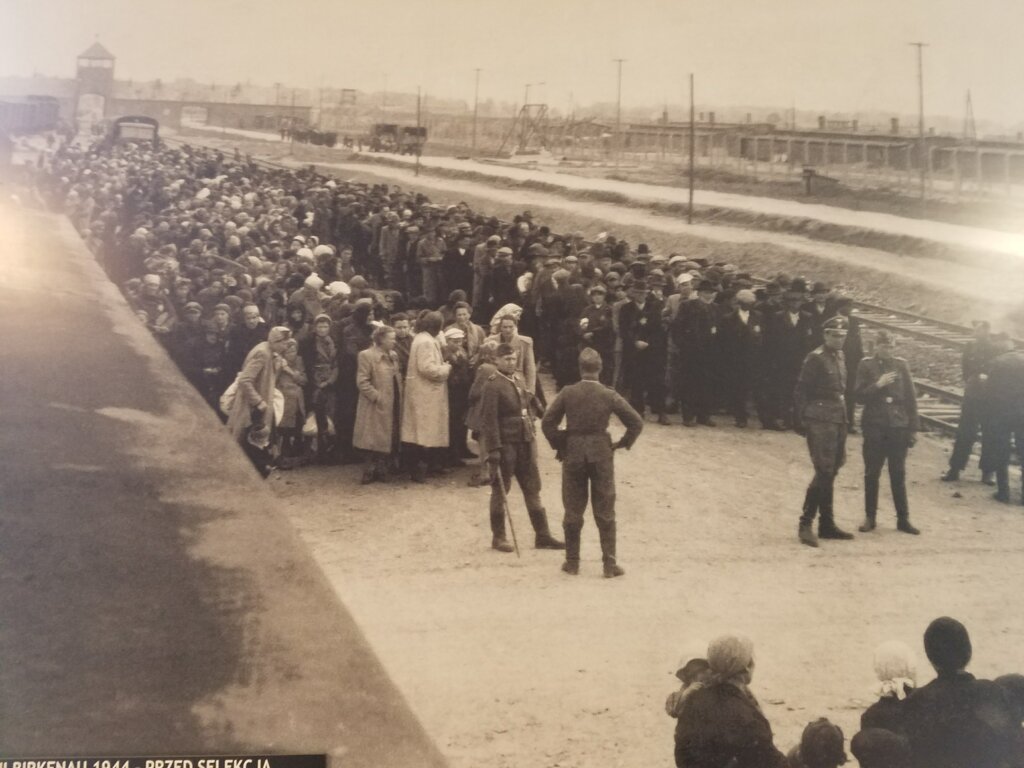
Despite this, by the time she was 5, her father had been deported to the Dachau concentration camp in Germany, and she and her mother to the Auschwitz-Birkenau extermination camp in Poland.
“If there wasn’t enough space in the cattle cars (train cars used to transport people to the death camps), they would be shot,” Friedman said. Her father would help “clean up” the dead, burying them naked, while her mother would wash the clothes from the dead so the German soldiers could send them to their families.
“Most of the people considered useful were in their 20s and 30s, working in the factories,” she said.
She recalled visits by Red Cross representatives who believed that the camps were “work camps” and would often be charmed by children singing during their visit. Nazis manipulated Red Cross visits to the camps to create a false impression of positive treatment, resulting in positive reports from the Red Cross that didn’t reflect reality.
Friedman said it took 36 hours for their train to get to Auschwitz-Birkenau, and she recalled being in the “dark, very thirsty and very hungry. I didn’t know where to go to the bathroom and kept asking my mother where I should go. I eventually realized everyone just went where they were standing.”
When they arrived at the death camp, they were stripped of their clothes and hosed down. “It didn’t make sense to me,” she said about the removal of clothing. “But we were considered subhuman. Subhumans did not need clothes.”
As a young girl, Friedman said she had “long, beautiful braids” that were shaved off upon arrival at Auschwitz-Birkenau. “I remember going from the complete dark of the cattle car into the sunshine. They took our shoes. We were given a tin cup, spoon and bowl, and my mother told me if I lost it, I wouldn’t be able to eat.”
For her 6th birthday, she was given a small package with a piece of bread in it. She didn’t want to eat it all and put it inside her shirt to save. Sadly, rats found the bread while she was sleeping and ate it.
“Every morning, they would come and get the sick and dead and take them to the gas chamber,” she said. She was kept contained in the kinderlager, or “children’s camp,” and survived starvation and a trip to the gas chamber on the one day that the chamber’s mechanisms malfunctioned because prisoners ahead of her had detonated an explosive in the chamber. She was again spared from another gas chamber because her tattooed number was not on the lists held by the Nazi officers running the chamber.
“The worst was getting sick; my mother said I couldn’t get sick,” she recalled. However, she did get sick after falling into the wide holes used for latrines and was taken to the camp’s hospital. After suffering from a high fever for about two weeks, she recovered and went to find her mother. She was told she had no mother.
Her mother eventually found her, but Friedman barely recognized her because her features were distorted by malnutrition, her body was puffy, and she was dressed in rags and was dirty, with sunken eyes ringed black from sleeplessness and starvation.
At that time, the German soldiers were rounding up people to walk to Germany in what became known as the Death March. Friedman’s mother didn’t think she could make it, and didn’t want her daughter to survive alone, in a “world that is not for children.”
They were able to escape from the lines forming the march and went into the women’s infirmary, where her mother went bed to bed, checking if the women were alive or dead. When she found a corpse finally that was still warm, she told her daughter to lie next to the body and not move. She positioned Friedman’s arms and legs so only the dead woman’s head was showing. She left her there, telling her to stay put until she returned.
When her mother returned, Friedman said they found the camp burning, and no signs of the German troops. “They didn’t want any evidence left,” she said. “They were evacuating the camp.”
Russian soldiers arrived Jan. 27, 1945, to liberate the camp. Friedman said she and her mother left Auschwitz in April. “There was an unofficial rule that if you stayed alive, you were to go back to your home, the last place you were seen,” she said.
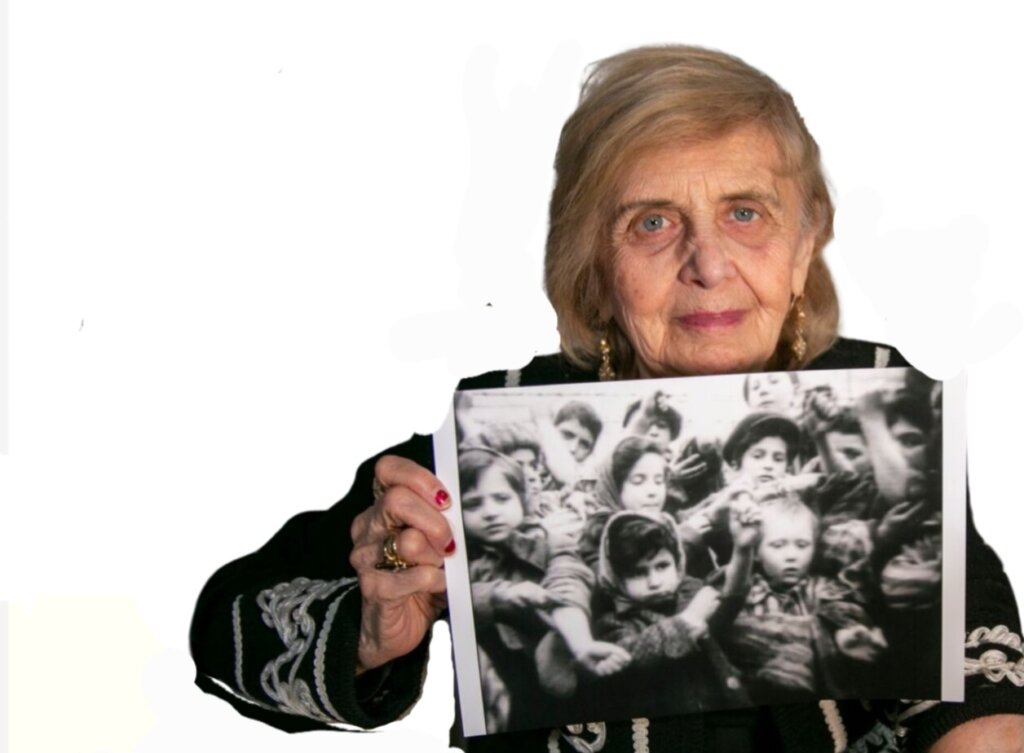
She still bears the identity imposed on her by the Nazis — A-27633 tattooed on the inside of her left arm. Soviet soldiers took a picture of her and other children showing their tattoos, which would later become an iconic photo of the war.
At home in Tomaszow Mazowiecki, Friedman and her mother learned about family and friends who survived, or didn’t. Eventually that summer, they learned that Friedman’s father would be coming home from Dachau, after being shot there by an SS officer.
However, they still faced prejudice as Jews, and eventually were smuggled into Germany to find American troops. They lived in Germany for three years at a camp for displaced persons before coming to the U.S. in 1950.
Friedman taught at the Hebrew University of Jerusalem and later was the director of the Jewish Family Service of Somerset and Warren Counties. She married, had four children and now has eight grandchildren. One of her grandsons made 100 videos of her sharing her history on TikTok (@tovafriedman), where she is thrilled that she has over a half-million followers, many non-Jews and young.
Today, she still carries evidence of trauma from her experiences: Certain German words remind her of the SS soldiers barking orders at the prisoners; she’s fearful of German shepherds, the dogs used by the guards at the camp, and traveling to Germany brings anxiety.
While she said she does not have “survivor’s guilt” from her experiences, she says, “The issues are in your tissues.” She considers her mission in life to share her story. “I’m here to say it happened. It’s a lifetime trauma, but I actively use my experiences to build a meaningful life in honor of those who died in the Holocaust. I will remember them. The power of memory is its importance to pass it on to another generation.”
The event also was supported by the Stockton University Sara and Sam Schoffer Holocaust Resource Center, the Jewish Leadership Council of Atlantic and Cape May Counties, and the Jewish Federation of Atlantic and Cape May Counties.
Contact the reporter, Karen Knight, at kknight@cmcherald.com.