

Get “The Wrap,” our take on the news of the week, in your inbox every Tuesday. Sign up at https://capemaycountyherald.com/newsletter-subscription.
Dec. 1 to 7
55,000 Vacancies
Second homes dominate the landscape in Cape May County’s island communities, from Ocean City in the north to Cape May Point at the southern tip. Second home owners are a topic of conversation on social media and on the Herald’s Spout Off pages.
The second home owners, their families and their friends account for a not insignificant chunk of the 800,000+ summer population in our county of less than 100,000 permanent residents. Every summer Cape May County goes from being the second-smallest county in the state to rubbing elbows with Essex and Middlesex counties in population size.
We do that in part because of the enormous number of vacant living units the U.S. Census Bureau tells us we have. In the county’s 11 island communities the permanent population has dwindled to a third of the county’s permanent residents, with four of those 11 municipalities with census head counts below 1,000. The only reason the islands can boast even that one-third of the county’s head count is because of Ocean City’s 11,000 permanent residents.
Yet those same communities contribute two-thirds of the total living units in the county, with 75% of those units vacant a significant part of the year. Those housing units include the vast number of second homes that have rapidly multiplied since the Covid pandemic, along with an increasing number of investment units purchased to take advantage of the new demand for computer app-based short-term rental bookings.
The 16 county communities, including the larger five on the mainland and the 11 smaller ones on the islands, have just over 55,000 “vacant” housing units, meaning for census purposes they are no one’s permanent home. More than 47,000 of those are on the islands.
What that adds up to, among other things, is that a small percentage of the county’s total population lives and votes in 11 island towns that house $80 billion in market real estate value. In Stone Harbor, for example, a roughly 800 individuals are the only ones who can vote and hold office on the governing body for a community of 1.5 square miles that is home to property valued at nearly $10 billion. It’s a pattern played out in a number of communities up and down the county coastline, a small group of voters in charge of a rapidly expanded property value base.
Paying More
To borrow a phrase from the great detective Sherlock Holmes (who incidentally borrowed it from Shakespeare in Henry V), the game’s afoot. Here we mean that regulators and lawmakers are engaged in the end-of-year tradition of adding expenses to the budgets of consumers while everyone is busy thinking of Santa Claus and family gatherings.
Already the state has announced a 4.2-cent increase in the gas tax beginning Jan. 1. Buying gas or diesel fuel in the new year will cost you 49.1 cents or 56.1 cents, respectively, in state tax.
Meanwhile, the Board of Public Utilities waited until after the November election to approve a 3.5% increase in the distribution rate for electricity in order to allow Atlantic City Electric to recoup investments it made in the local grid and also include a guaranteed return on equity for the utility’s investors. A decision on the rate increase had been postponed several times before the election while energy costs and ratepayer bills were hot campaign topics. This increase went into effect Dec. 1.
Not to be outdone, Trenton lawmakers are advancing a bill ironically called the “New Jersey Energy Reliability and Affordability Act” under which “a qualified advanced nuclear reactor project would be eligible to receive funding for a negotiated percentage of construction costs through a non-bypassable charge which would be imposed on all electric utility customers and deposited into a fund to be known as the Advanced Nuclear Development Fund.” What that language means is that ratepayers would start paying an extra fee now for probably a 10-year period during which a new nuclear plant would be constructed.
According to the state’s ratepayer advocate, Brian Lipman, this fee could tack on anywhere from $22 to $55 to the monthly bill of an average utility customer. This bill is moving through the Legislature just weeks prior to the inauguration of a new governor who has pledged to control energy costs.
Keep your eye on Trenton because the end of the year can be a treacherous time for taxpayers. While you’re at it think about downgrading that roast for Christmas dinner. Meatloaf is always nice. You’re going to need the extra funds in January.
Starter Homes
One of the cornerstones of the American dream is increasingly out of reach. According to recent poll results from Gallup, less than a third of non-homeowners expect to buy a home in the next five years. Survey results suggest that home ownership rates are not likely to advance substantially in the near or even moderate term. Survey respondents feel priced out of the market. The percentage of those surveyed who plan to buy a home in the next five to 10 years is the lowest Gallup has recorded.
The survey results suggest that the decision not to buy is not a voluntary choice non-homeowners are making. “Renting appears to be more a result of economic circumstances than an intentional lifestyle choice,” Gallup says. Respondents say the cost of home ownership and the required downpayment are the biggest barriers they face. The inexpensive starter home is increasingly difficult to find.
While 45% of survey respondents said they could not afford to buy a home in 2013, 68% said that in 2025.
According to Wharton experts, “We are at a 40-year low in measures of affordability, which is why the young generation is having difficulty in becoming homeowners.”
The starter home is being pressed by rising land values, fierce competition and shrinking supply. Location is also a major difficulty in that home buyers want to own where other opportunities for career growth and strong schools are present, the areas most likely to see increasing prices.
Realtor.com places the median price of a “starter home” in New Jersey at $423,000. A far cry from what many of us from older generations remember from when we were starting out.
Week in Review
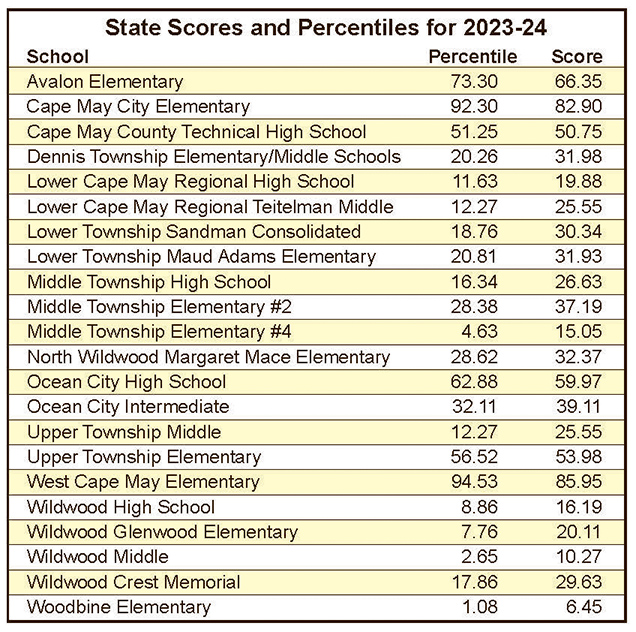
*The state Department of Education has released its latest ratings for every public school in New Jersey except those that only have grades pre-K to 2, and the results for Cape May County overall were not good.
*The sentencing of former Wildwood Mayor Peter Byron has again been delayed – this time until after the New Year – and trials for two other current city officials will likely be held in 2026 as well.
*The whistleblower case filed against Howell Township by current Stone Harbor Borough Administrator Joseph Clark is heating up.
*Lower Township is adding five new pickleball courts, which will give the township seven regulation pickleball courts in addition to a number of tennis courts lined for pickleball.
*With less than two months left in office, Gov. Phil Murphy has released a revised state Energy Master Plan, an 89-page document that contains recommendations and goals that seek to shape the state’s energy profile and large segments of its economy for decades into the future.
*A Cape May County grand jury handed up 14 indictments Dec. 2.
*Agriculture Secretary Brooke Rollins told President Donald Trump that his department was prepared to cut off federal funding of the Supplemental Nutrition Assistance Program – SNAP – for New Jersey and 21 other states.
*The Stone Harbor Borough Council has introduced an ordinance that would establish a 3% occupancy tax on hotel and motel rooms and also on certain accommodations for transients and short-term rentals booked through third-party computer applications like Airbnb and Verbo.
*Wanting to see how a specific school, Crest Memorial School in Wildwood Crest, was dealing with education performance issues, the Herald spent time with top administration officials.
*Ocean City Mayor Jay Gillian announced in an email blast to city residents that he is filing for personal bankruptcy.
*A harassment lawsuit filed by a Stone Harbor borough employee against the borough and it previous administrator, Manny Parada, has been “amicably resolved” by the parties, according to court papers filed Dec. 1.
*Two young friends, Brian Patrick Smith Jr., 22, and Cody M. McKernan, 18, died in an accident on the Garden State Parkway early Thanksgiving morning.
*Two police departments in Cape May County have made it a tradition to give toys to less fortunate children in the community during the holiday season.
*A bill that would revamp regulations regarding e-bicycles has been advanced by the Senate Transportation Committee in a unanimous vote.
*Gov. Phil Murphy declared a statewide drought warning on Friday, Dec. 5, authorizing the state Department of Environmental Protection to closely monitor water supplies.
*The Ocean City Planning Board has been asked to determine if the Wonderland Pier site at Sixth Street and the boardwalk meets the requirements of an area in need of rehabilitation.
*Taylor Henry, president of the Wildwood Historical Society, says that boardwalk tram car No. 8 will be the most important object the society has ever preserved, a restored 1960s transporter that could be the crown jewel of the society’s museum.
*A bill advanced out of the Senate Budget and Appropriations Committee could tack an extra $22 to $55 onto consumers’ monthly electricity bills.
Spout Off of the Week
Re: the article on low test scores in CMC schools. I asked a veteran teacher what she thought. She said in her district there is a no retention policy at the middle school so kids who fail classes (sometimes all of them for 2 years) are not held back. She added that expectations are also low in the HS. Finals were eliminated, passing dropped from 70 to 65, and the “college bound for all” resulted in lower standards so more kids would pass. She said teachers who try to “raise the bar” often face opposition from the building principals.
North Cape May