MIDDLE TOWNSHIP – School District Superintendent Stephanie DeRose was open about problems facing the district – chronic absenteeism, a large population of homeless students, a lack of funding for facility upgrades – but was optimistic that the district can work toward better outcomes as it prepares its five-year strategic plan.
To see Middle Township’s 2020 – 2025 strategic plan, click here.
DeRose addressed a group of roughly 40 parents, teachers, school administrators and community members at a Nov. 11 town hall designed to gather input about what the district is doing well, and what it can do better.
Feedback and ideas from the community will be incorporated into the new strategic plan, which DeRose said will be ready for Board of Education approval in March 2026 for implementation that fall.
She was quick to address last year’s failed referendum. Township residents, in a September 2024 vote, said no to a ballot question that would have allowed the district to bond $26.5 million, aimed mostly at facility upgrades. The money would have gone toward new pre-K classrooms at Elementary School 1 and a renovated space for second graders at Elementary 2.
The district planned to give Memorial Field a makeover, with new bleachers, improved drainage and synthetic turf to replace its grass. The district also planned to upgrade aging cooling and heating systems across its school buildings.
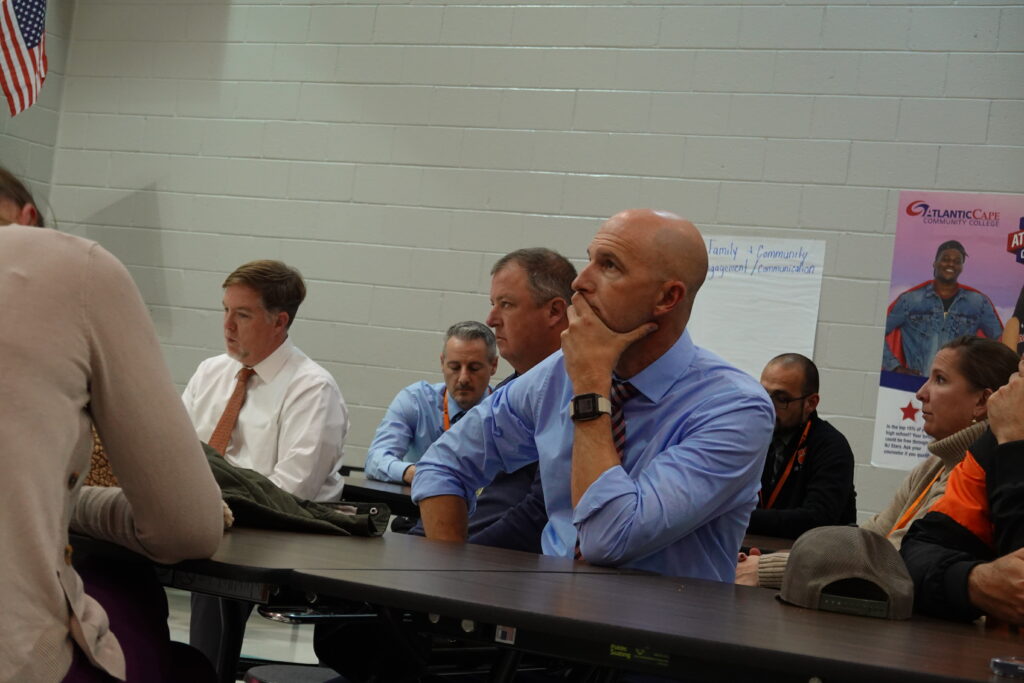
“I know that the topic we try not to address is the referendum,” she told the room. “One thing you will learn about me is that I’m not shy from confrontation and I like to hit it head-on.”
She asked parents and community members, via a Google survey, to identify the district’s strengths, weaknesses, opportunities and threats. The town hall was designed to get additional input from anybody who showed up.
“This isn’t about Superintendent Stephanie DeRose and what she wants to do. This is a community-led process,” she said.

Weaknesses were identified by survey respondents, and others by DeRose. Respondents said that they would like additional classroom support, a better system to onboard new families, and better Wi-Fi connection across the district. Teachers and staff who responded said that their pay and benefits are not competitive with other districts.
“We have to have fair compensation that is competitive,” DeRose said.
She said that the district has to deal creatively with problems that would have been solved in part by the referendum’s funding.
“Based on the growth of the community, our student population may grow and our space is limited. We are already busting at the seams at Elementary 1 and Elementary 2,” she said.
“Not to mention facility needs. We have HVAC projects where things are not being utilized efficiently. We have moisture issues, and a slew of other factors included in that. And then there’s the turf field…
“We want our students once again to be on an equal playing field, no pun intended, with other districts. Our students, by not being on turf for many of our sports and only practicing on grass, are at a detriment within the land of competition … They are competing at a deficit.”
She did not give specifics at the town hall, but stressed that the strategy will have to deal with these issues. She also reminded attendees that Middle Township is not an Abbott district, meaning it does not receive the same level of state funding that many other New Jersey districts rely on for facility improvements. “Because of that, referendums become necessary,” she said.
The creation of a five-year strategic plan is typical for schools in New Jersey. For the 2020–2025 strategic plan, an outside group of consultants was brought in to put together the plan and to identify the district’s needs.
But this time, DeRose told the Herald, “I wanted to get my hands dirty. I wanted to facilitate the process myself, and I wanted this to be a transparent thing.”
The school district is fighting against systemic factors. Chronic absenteeism is an issue across New Jersey, DeRose said, and Middle Township is no exception.
The district also has to face the reality that the district has a poverty problem. According to the district’s latest data, 57% of students qualify for free or reduced lunch, although the criteria for who qualifies have expanded since the COVID-19 pandemic.
“That’s the highest it has ever been,” the superintendent said. “We have 200 students who are homeless in our district. We are challenged with upholding educational standards and learning. But that is difficult when their basic needs are not met.”
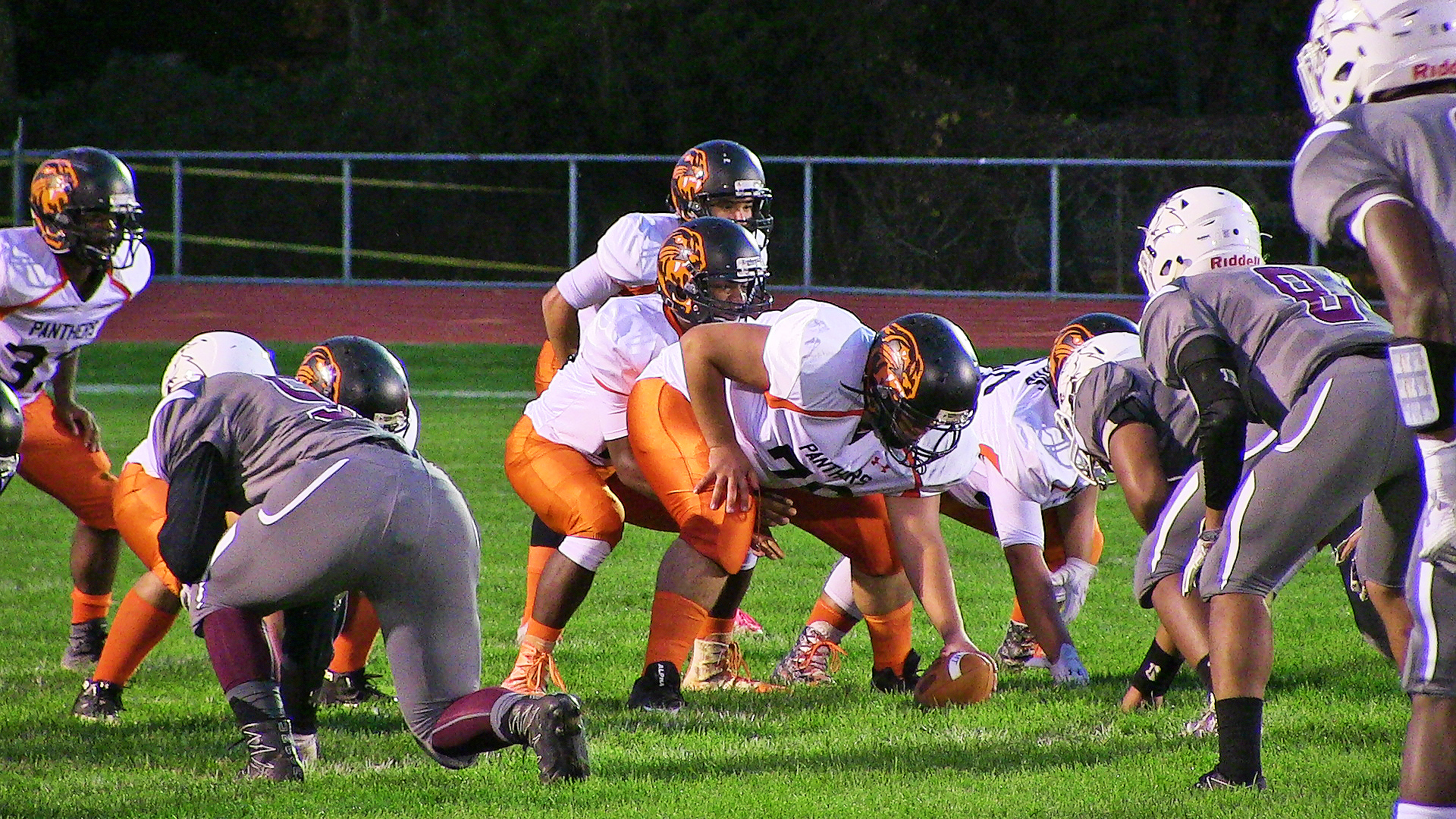
Still, DeRose is optimistic that the schools can come up with a strategy that works for all children. Survey respondents identified many positive things about Middle Township schools that they take pride in. Families and staff said they value the district’s dedicated teachers, its emphasis on safety and well-being, the broad range of athletics and arts offerings, and the feeling that, in the words of an anonymous respondent, “being a Panther feels like being part of a family.”
Respondents were also asked to identify opportunities for change within the district. Preschool expansion was a major theme. People also want practical skills, like auto care, financial literacy and home care, taught more broadly. Others suggested increased mental health resources, more vocational programming and clearer instructional support systems for teachers. DeRose added that the district is exploring how to incorporate AI across the curriculum in age-appropriate ways.
Many respondents, both in the survey and at the town hall, want the district to better engage with the wider community. Town hall attendees were asked to brainstorm ideas for this and other topics. People overwhelmingly asked for more community events outside of school hours. One parent suggested a “community happenings page” could make it easy for anybody to see when events are taking place. Several also expressed interest in bringing back a parent-teacher organization, though DeRose said that these groups tend to fizzle out quickly.
DeRose said the final plan will be organized around six core categories: efficient resource allocation, facilities and technology, staff recruitment and retention, student well-being, family and community engagement, and teaching and curriculum excellence. Subcommittees for each area will meet throughout the coming months to create goals that she described as SMART: specific, measurable, actionable, responsible and timely.
“We are creating a strategic plan for our future. We need to develop actions that get us where we want to go,” DeRose said.
Contact the writer, Collin Hall, at 609-886-8600, ext. 156, or by email at chall@cmcherald.com.